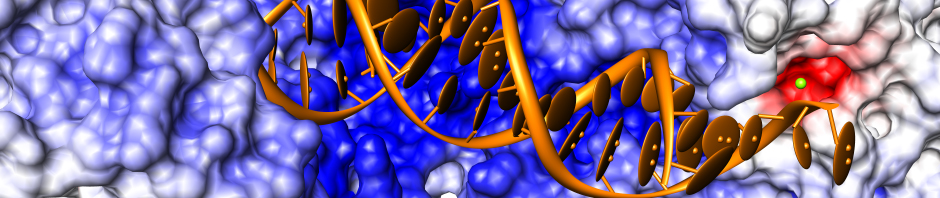
Jmol goes JavaScript

JmolAbout 10 years ago, I turned the Jmol project over to a series of fantastic lead developers (Jmol programmers regenerate in different bodies just like Doctor Who does).  Since then, the aspect of the new work on Jmol that has most delighted me is the Jmol applet, which allows the program to be embedded in web pages.   The Jmol applet transformed Jmol from a niche application into a way of broadly disseminating and interacting with chemical structures.  It has become the de facto standard for showing protein structures at the RCSB Protein Data Bank, as well as in a number of chemistry journals.

The problem with Java applets is that many new tablet and phone web browsers don’t support them (and it looks like Java applets are being slowly disabled on Mac browsers as well).  Java has always been an elegant but relatively heavy-weight solution to dynamic content, but I think its time as a widely-used language for web content is coming to a close.

So, how do you interact with chemical structures without Java or Flash?

The Jmol team has been hard at work converting the Jmol source so that the same source code that produces the Jmol applet can also be run through Java2Script to create the entire Jmol applet in JavaScript.   The new beast is called JSmol and has almost all of the functionality of Jmol itself (file IO, scripting, etc.)    Bob Hanson’s demo pages give a taste of this work.

This is amazing work.  The same Java code is compiled to create the Jmol applet, a WebGL version of JSmol, and the HTML5 version of JSmol that can run on my phone. Almost all of Jmol is there – the ability to display orbitals, crystals, and van der Waals surfaces.  Some menu interaction is still missing, but if the goal is to display and interact with a chemically meaningful structure on a web page,  JSmol looks like a great solution.

The credit for this work largely goes to a number of people:  The GLmol interface was written by Takanori Nakane.  Java2Script was written by Zhou Renjian.  The Jmol code conversion to JavaScript was done by the current Doctor Who,  Bob Hanson.

VN:F [1.9.22_1171]
Rating: 4.3/5 (7 votes cast)
Posted in open science, Science, Software | Leave a comment

Octopus – A cool open source TDDFT code

OctopusI just found out about Octopus, a quantum mechanics package that does time-dependent density functional theory (TDDFT) calculations using pseudopotential approximations.

It works in parallel using MPI and OpenMP and scales to tens of thousands of processors. It also has support for graphical processing units (GPUs) through OpenCL.

The Octopus code can be browsed freely, and it has been released under the GPL.

Particularly cool is the ability to use the time dependent electron localization function (TDELF) to look at orbitals dynamically during a chemical reaction.

VN:F [1.9.22_1171]
Rating: 0.0/5 (0 votes cast)
Posted in open science, Science, Software | 1 Comment

Why aren’t voting machines required to be Open Source?

If ever there was a need for the transparency that open source software brings it is in the realm of voting machine technology.    This story makes that point crystal clear.   There may or may not be shenanigans going on in Ohio.  The point is that we have no way of knowing what the patches on those Ohio voting machines actually do, and no faith in the code reading, debugging, and auditing ability of elected officials.   If we want to be confident in the workings of our democracy, closed-source voting machines should be banned.

For that matter, why aren’t voting systems required to leave a physical paper trail so that we can check up on the tabulating algorithms?

VN:F [1.9.22_1171]
Rating: 4.7/5 (3 votes cast)
Posted in Policy, Software | Leave a comment

PhD Comics tackles Open Access

Fantastic comic / video by Jorge Cham on Open Access over at PhD Comics:

www.phdcomics.com/comics.php?f=1533

The voices behind the video are Jonathan Eisen and Nick Shockey (director of the Right to Research Coalition), and the discussion covers the insanity of the closed-wall access to publicly-funded research as well as the importance of re-use towards discovery.

Posted in Open Access, open science | Leave a comment

Open source fonts

Adobe released an open source font today called Source Sans Pro.   It looks super clean and nearly perfect for user interfaces.  Right now it comes in six weights, but a monowidth version is coming soon.  (I’m most excited about this, as the sample of the monowidth font on the Adobe blog post is gorgeous).    Adobe did this right – they have made all source files used in the production of the fonts available for download at SourceForge.

Maybe we’ll get more scientists using Source Sans Pro instead of releasing their important results in Comic Sans.

VN:F [1.9.22_1171]
Rating: 0.0/5 (0 votes cast)
Posted in Fun, Software | 1 Comment

Data visualization and Digital Research tools

Two new collections of tools that may be of interest to the OpenScience community.  Not everything on these lists is Open Source, but many of the visualization and research tools look to be very useful.   Hat tip to Eric Lease Morgan (@ericleasemorgan) for pointing these out:

  1. http://selection.datavisualization.ch – A collection of tools that the people behind Datavisualization.ch, work with on a daily basis and recommend. This is not a list of everything out there, but instead a thoughtfully curated selection of our favourite tools that will make your life easier creating meaningful and beautiful data visualizations.
  2. Bamboo DiRT is a tool, service, and collection registry of digital research tools for scholarly use. Developed by Project Bamboo, Bamboo DiRT makes it easy for digital humanists and others conducting digital research to find and compare resources ranging from content management systems to music OCR, statistical analysis packages to mind mapping software.
VN:F [1.9.22_1171]
Rating: 0.0/5 (0 votes cast)
Posted in Open Data, open science, Software | 1 Comment

Computational Chemistry Highlights

Computational Chemistry Highlights (CCH) is an interesting new overlay journal that identifies important contributions to the field of computational and theoretical chemistry published within the last 1-2 years.  I’m involved in this particular overlay journal – I’ll be concentrating on recent developments and papers in molecular dynamics and statistical mechanics.  The journal will eventually get to an editorial board of around 50, so it will help us all keep up on advances in the field that are outside our specific areas of expertise.

Overlay journals are a great concept – CCH is not affiliated with any publisher: it is a free resource run by scientists for scientists.  In addition to highlighting recently-published papers, I’m pretty sure it will also include highlights of non-journal resources like code, publicly available datasets, and papers available on preprint servers (e.g. arXiv, Nature Precedings).  It also allows non-anonymous comments on papers and will let authors respond to those comments.

Overlay journals are an interesting experiment. We’ll have to see how important they become, but I’m pretty happy to be included early on this one.

VN:F [1.9.22_1171]
Rating: 4.3/5 (6 votes cast)
Posted in Open Data, open science, Science | 1 Comment

Open Science consulting gig with the American Heart Association

I just got notification about a short-term consulting gig with the American Heart Association that is specifically related to issues of Open Science:

The American Heart Association has recently formed a task to explore and determine AHA’s role in open science.  Our specific interest at this time is focused on data repositories for finalized research data.  We are currently looking for a consultant to assist in gathering background information for this task force in the following areas:

  • What open science is, and how it relates to the AHA.  This should be approached more broadly than just our data focus so the committee is aware of other research transparency opportunities.
  • What other similar organizations are doing relative to open science and making data and publications available (e.g. NIH, HHMI, ACS, EU, etc.) The AHA can provide contact information within most these organizations.  We would like to see comparisons to about 6 similar organizations.  Our publishing area has looked at policies related to public access to publications, but this task force will be looking at how open access could impact our research program.
  • Existing repositories in use which can hold the types of data that AHA funded grants produce.
  • Legal, data design, or intellectual property issues with requiring researchers to store their data in a repository.
  • Documenting issues that should be addressed by the task force if they decide to move forward (e.g. timing for providing data, retention of data, definition of data to store, requiring common terminology, issues related to the re-use of the stored data etc.)

We anticipate that these efforts may involve the consultant 5-10 hours a week for a 6 week time period.   The project will begin in mid-October and would ideally be completed by Dec 1st.  Consultants that are interested in this project should provide a summary of their qualifications by October 12th.


Belinda Orland

Research Information Manager

Division of Research Administration


American Heart Association/American Stroke Association 

7272 Greenville Avenue
Dallas, TX 75231
214 360 6110
belinda.orland@heart.org

Posted in Uncategorized | Leave a comment

Advice to junior faculty who want to do get promoted doing Open Science

I recently sent some advice to a colleague who is coming up for tenure at another university.  He’s quite well known in the Open Science community and is trying to figure out how best to make the case to his tenure committee that the open science contributions he has made in addition to his traditional journal publications are important.  We’re talking some major contributions here — lab protocols on OpenWetWare, open lecture materials on slideshare, data files released with CC0, videos of lab protocols on Benchfly, and he’s a regular contributor to science discussions on FriendFeed.

The advice I gave him was basically to make the committee’s job of measuring these contributions easier.  Here’s the advice (in a slightly edited form):

The audience for most tenure documents (and particularly the external letters) is a committee of non-specialists that advises the provost or other high-ranking administrator.  These committees are often somewhat skeptical of departments and candidates and are looking for external validation of what they are reading in the tenure dossier and the packet prepared by the departments.  They are swayed by real experts in the field (named chairs at other institutions, national academy members, people at top 10 institutions) and by things they can measure (publications, h-indices, grant money, citation counts). If you want to add a non-traditional contribution to a tenure dossier, you should also include a way of measuring the importance of that contribution.

First, if the rules of your institution allow it, make sure there is a strong defense of open ways of doing science in your dossier (1-2 paragraphs or so).  Make the case that it is important to consider non-standard contributions even though previous tenure committees did not.

Use as many metrics to back up your contributions as you can. Make a case that each of your software releases counts as much as a full publication, and use download statistics as if they were directly comparable to academic citations.  List external users of your software as if they were research collaborators, because they are!  If you can collect them, include download statistics on open contributions to sites like OpenWetware and Wikipedia.

If your institution’s rules allow it, make sections directly under your publications for  ”Published Datasets”, “Contributed Software”, “Published Protocols & Notebooks”, “Scientific Videos”.  In each section, list authors, a title, description, and URL of the resource you have contributed along with a count of downloads or views, and a list of other groups using your data. Make this look as much like your publication section as possible, as you can then make the argument that these things should be treated with a similar weight to traditional academic publication.   Provide the metrics in the document so that your committees aren’t guessing about how important something is.  I can’t emphasize this enough – citation counts are easy for a committee to dig up – download stats are harder.  Do the measurement work for your committee and they’ll make the assumption that your metrics are important.

So that’s the advice.  I’ve been involved in a few internal tenure discussions, and the metrics are always important.  If there isn’t an easy analogy to something in my own experience, I look to the candidate’s documents and the external letters to tell me why something matters.

Posted in open science, Science | Leave a comment

An informal definition of OpenScience

Over at the open-science mailing list at okfn.org, Michael Nielsen just posted a great “informal” definition of open science:


Open science is the idea that scientific knowledge of all kinds should be openly shared as early as is practical in the discovery process.

The discussion on the list has been very interesting, but that particular “informal” definition is great because it gets at why we’re struggling with established social norms in science given the new technological methods of communicating results:


…when the journal system was developed in the 17th and 18th centuries it was an excellent example of open science.  The journals are perhaps the most open system for the dissemination of knowledge that can be constructed — if you’re working with 17th century technology.  But, of course, today we can do a lot better.

Posted in open science, Science | Tagged , | 6 Comments